The Threads That Travel Between Us
A review of Rebecca Stead's novel When You Reach Me

“Mom says each of us has a veil between ourselves and the world…And when the veil lifts, we can see the world as it really is, just for those few seconds before it settles down again. We see all the beauty, and cruelty, and sadness, and love. But mostly we are happy not to.
“I’ve thought a lot about those veils. I wonder if, every once in a while, someone is born without one. Someone who sees the big stuff all the time. Like maybe you.”
I read When You Reach Me by Rebecca Stead when I was in 7th or 8th grade. Sonlight, our homeschool curriculum, assigned the book directly after Madeleine L’Engle’s A Wrinkle in Time. It was a stroke of genius. Stead’s novel is a love letter to L’Engle’s classic; protagonist Miranda talks about the book’s plot and key scenes to other characters. Having finished A Wrinkle in Time the week before, I was able to track right along. But Stead’s work is a classic in its own right. Her brief chapters and underwritten dialogue mask a perspicuous narrative filled with observations about the way we treat strangers and social outcasts, and her description of time travel remains the closest anyone has come to convincing me that time is relative.
Miranda is a 12-year-old girl living with her mom and her mom’s boyfriend in downtown Manhattan. She is a “latchkey child,” meaning that she has a key to the apartment and is largely left to her own devices after school. She knows how to watch out for unsavory people on the street, like the local toughs by the garage and the homeless man on the corner. And she is a keen observer of people and the reasons they do things. But one day, her life turns upside down when a strange boy named Marcus punches her best friend Sal. Miranda and Sal had been inseparable: they’ve known each other since Miranda moved in, and they even slept next to each other at the same daycare for years. But now, their friendship suddenly ends, and Miranda doesn’t know why. Even more perplexingly, she receives an anonymous note: I am coming to save your friend’s life, and my own. The notes continue as Miranda’s friendships start to unravel in every direction. As Miranda tries to solve the notes before tragedy strikes, she also tries to understand why, the closer she clings to her friends, the faster they drift away.
Spoilers ahead. This book is a masterpiece, so if you haven’t read it before, I recommend that you go borrow the book from the library and read it before you proceed.
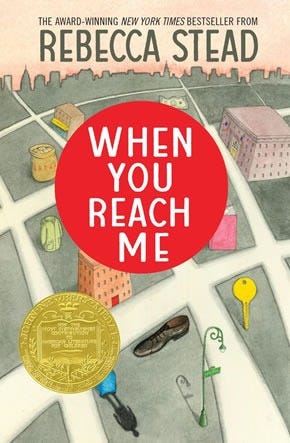
When You Reach Me is a book with three layers. The first is the elliptical plot, the kind that needs to be read twice for full effect. The book actually demands this in the intro. “I still think about the letter you asked me to write. It nags at me, even though you’re gone and there’s no one to give it to anymore.” It would be heavy-handed if the mystery weren’t central to the book and to Miranda’s development. Miranda talks to the individual throughout the book, and much of the dialogue comes right before her critical conversation about time travel with Marcus and Julia. The time travel explanation, which Julia illustrates with her diamond ring, creates a plot that starts at the end of the book, rather than the beginning, in much the same way as Tenet or Interstellar. The conversation about the plot hole in A Wrinkle in Time is far too long to reproduce here, but it’s fascinating to watch Marcus slowly see where Miranda is confused and point out her misunderstanding to her. The long and short of it is that the past, present, and future exist simultaneously, like diamond chips on a ring. Usually we think of time as jumping between the diamonds, but since past and future are both relative to a person’s experience, a person could theoretically jump from one diamond to another without going forward in time. This explanation is too simple to deal with the many paradoxes of time travel, but 8th grade me found it fascinating. By the end of the book, Miranda finally pieces it all together, and her conclusions invite the reader to start at the beginning again, so that the book itself becomes a ring of sorts.
The second layer is the Winner’s Circle game show. Throughout the book, Miranda helps her mom prepare for The $20,000 Pyramid, a real-life 1970s game show on which she becomes a contestant. Part of the game (the Winner’s Circle) forces contestants to name the correct category when prompted with three items in that category. Mom’s invitation comes as a total surprise to everyone but the person writing the notes, who seemingly predicts the event over four months beforehand as a final proof to Miranda. But the biggest surprise is hidden in the chapters themselves. With a few exceptions, Rebecca Stead titles each chapter “Things You ___,” and each chapter titled this way has three things that fit into the category. Stead is thus playing the Winner’s Circle with her readers: only she has come up with the category, and the reader has to identify the items. (Note: this means that Stead had to play the game with herself while she was writing, which makes me think she was a fan of the show.) Chapters range from easy, like “White Things,” to incredibly difficult, like the chapters directly before and after Miranda finds the first note. Even present-day me struggled to find all the answers. But the search was rewarding, because it pointed me to the physical markers of Miranda’s changing perspective on life and friendship.
The third layer is Miranda’s arc, as she learns to show sympathy and release old grudges. Initially frightened of Marcus, Miranda slowly befriends him over their shared fascination with A Wrinkle in Time. But she never tells Sal that Marcus is an ok person, allowing him to live in crippling fear of Marcus until the very last page. Most likely, this is because Miranda resents Sal for shutting her out of his life, but Stead doesn’t say explicitly. However, an almost identical conflict happens with Marcus’s friend Julia. Miranda decided that Julia was an unfeeling, elitist brat over one or two incidents in second grade, and treats her coldly because of them. Julia’s present-day behavior doesn’t help: she is loud, insistent, and flaunts her wealth at a school where students like Miranda live in run-down, grungy apartments where dust, bugs, and the smell of cigarettes are everywhere.
Miranda finds Julia obnoxious, and unconsciously tries to drive a wedge between Julia and her friend Annemarie. Her perception of Julia cracks a little when she sees Julia care for Annemarie during a epileptic seizure. However, things get worse before they get better. A local racist store owner calls Julia “hot chocolate,” inspired by Miranda’s snarky nickname for her (Julia is black). Annemarie holds Miranda responsible, and the two don’t reconcile until the start of the next term. But Miranda’s compassion is slowly growing, as evidenced by the sandwich she gives to the homeless man on the corner. And this compassion bursts into flower towards the end, as Miranda suddenly realizes her pettiness and drops her grudge against Julia. In a subsequent visit to her house, Miranda also realizes that Julia’s mom is also emotionally checked out of her daughter’s life, and the two girls start to bond.
Miranda is perceptive and has an active inner dialogue and high emotional intelligence, but becomes increasingly isolated and lonely over the course of her sixth grade year. She and Sal had been inseparable growing up: they went to the same daycare, and young Miranda could never sleep unless Sal’s feet were touching hers. With Sal gone, there’s no one she can talk to about the secret letters, and her mom becomes less and less emotionally available as her relationship with her boyfriend shifts. In chapter 26, “Salty Things,” Sal’s mom tells Miranda she misses her, which makes Miranda feel “sort of hopeless for some reason.” Curiously, the third salty thing from the Winner’s Circle game appears to be missing here, which makes me think that Miranda wants to cry and doesn’t realize it. A large part of her surprise turnaround over Christmas may be the shared celebration with her mom’s boyfriend, whom she trusts to keep secret their present for her mom. This trust may have given her the emotional foundation needed to let go of her loneliness and insecurity.
When You Reach Me was Rebecca Stead’s second novel. It won a Newbery Medal and got on the NYT bestseller list, among numerous other awards. Stead is known for many things: children’s books, persistence, currently being alive. (Mandatory Liam Vickers reference.)
She grew up on Manhattan’s Upper West Side in the 1970s. According to Wikipedia, she worked as a public defender before she had children and returned to writing, furthering my theory that Miranda’s mom may be a subtle self-insert character.
Another thing that stands out on the second reading is Stead’s emphasis on bullying, acceptance, and social outcasts. Between Marcus, Annamarie, and the crazy homeless man, I’m convinced Rebecca Stead knew someone with autism. But it’s possible her focus is more on everyday bullying and how to respond to it. Stead said in an author interview with Horn Book, “I feel like there are stages in many, many people's childhoods when you don't have one good friend like that. It can happen a lot in sixth and seventh grade because that's when things are changing so quickly. It’s like a desperate dash for some kind of acceptable identity, and it can get ugly.” Stead herself only had one friend in middle school, and they were occasionally bullied for being as close as they were.
But When You Reach Me is not just A Wrinkle in Time set in 1970s Manhattan. Nor is it a lesson on how to treat people who seem odd or strange. At its core, the book is about letting the people you love develop their own friendships, even if it means they drift away from you.
In a chapter called “Things You Push Away,” Miranda shares a piece of wisdom from her mom. Most people, her mom says, have these invisible veils in front of their faces, veils that prevent them from seeing the bigger picture — all the beauty and ugliness in the world, and maybe a lot of the ugliness in themselves, too. “She doesn’t mean that it’s a real veil,” Miranda explains. “And it isn’t about magic, or some idea that maybe God is looking right at you, or an angel is sitting next to you, or anything like that.” People just “get distracted by the little stuff and ignore the big stuff.”
But some people learn to lift the veils and force themselves to see the world in all its complexity. Others, like Marcus, don’t have a choice. Miranda thinks, “I wonder if, every once in a while, someone is born without one. Someone who sees the big stuff all the time. Like maybe you.” Over the course of her sixth grade year, Miranda learns to lift her veil and see the bigger picture in people, seeing them for the people they are rather than the people she wants them to be. At Julia’s house, Miranda gets to see that Julia does like the clothes and jewelry her mom buys her, but she also likes space and science and A Wrinkle in Time, just like Miranda. Julia turns out to be far more kind and quirky than Miranda thinks at first.
After the accident gives her the opportunity to mend her friendship with Sal, Miranda realizes that their friendship had started decaying well before Marcus punched him. It wasn’t his fault or her fault or Marcus’s fault; it just happened on its own. And that was ok. The loss of Sal forced her to find other friends, and, more importantly, to let down her walls and become more easily befriended. Reunited with Sal, Miranda says, “we are better this way, together because we want to be. He understood that before I did.” I’ve remembered this line ever since. Together because we want to be. Those are the kind of friendships I long for. Friendships that transcend the boundaries of time, space, and even death. Friendships that last forever.
So, yeah, that’s about it. Time is like a diamond ring, close friends are good but not everything, and some people walk around with constant awareness of the big stuff. (Hey, maybe that’s me.)
Thanks for reading. I promise that not all the posts will be three-point essays like this one. (But most of them will be.) It’s not my fault I think in paragraphs of 80-90 words. My beloved college history teacher is to blame for that. But that’s a post for another time.
Obsessed with this. I haven’t read this book in forever but I think I maybe need to reread. I love Rebecca stead’s work and I also forgot how tightly this book is wound in with Wrinkle in Time! I’m going to reread both back to back, I think. It’s been a lot of years. Going to try it.
Obsessed with this. I haven’t read this book in forever but I think I maybe need to reread. I love Rebecca stead’s work and I also forgot how tightly this book is wound in with Wrinkle in Time! I’m going to reread both back to back, I think. It’s been a lot of years. Going to try it.